Amazon FSx Alternatives for Multi-Cloud Teams
Storage locked to AWS becomes expensive across clouds—here's what works instead.
Amazon FSx does one thing extremely well: high-performance managed file storage inside a single AWS region. That's also its one real constraint. For teams whose compute roams across AWS, GCP, and Azure, the right FSx alternative depends on which specific limitation is actually costing you money or speed.
What Amazon FSx is and what it does well inside AWS
Amazon FSx is a managed family of file services built for AWS-native workloads. You get two distinct products for two distinct jobs. FSx for Windows File Server handles SMB and Windows workloads. FSx for Lustre handles HPC and machine learning training.
The Lustre product is the one that matters for performance-sensitive work. Its architecture stripes data across multiple storage servers, so many GPU instances can read at once at maximum bandwidth. It also integrates directly with S3. You point it at a bucket, it imports that bucket as a data source, and you process it with Lustre performance. Results write back to S3 when you're done.
Inside a single AWS region, FSx is genuinely strong. It beats plenty of competitors on high-performance file systems because of that seamless integration, built-in redundancy, and scalability. Intra-region data transfer between AWS storage and compute costs you nothing. That's a real advantage. It just evaporates the moment data crosses a cloud boundary.
Where FSx's AWS coupling becomes a structural problem
FSx is not deployable outside AWS. That single fact creates three distinct problems for multi-cloud teams. If your roadmap includes Azure, GCP, or governance-driven cloud diversification, you can't extend your FSx deployment. You have to replicate or migrate the storage. Those are very different projects, and neither is cheap.
Egress fees are the second problem. They're a deliberate pricing mechanism, not an accident of infrastructure. At meaningful data volumes, the per-gigabyte fees for data leaving AWS accumulate into a significant share of total cloud spend. The free intra-region transfer that makes FSx attractive disappears entirely when your compute runs elsewhere.
The third problem is consistency of interface. Teams running the same workload across clouds face a choice: rebuild storage architecture for each cloud or accept divergent file semantics. Neither option is operationally neutral. You either duplicate engineering effort or live with different behavior depending on where the job runs that day.
Why egress pricing turns multi-cloud storage into an economics problem before it becomes a technology problem
Cloud providers made a pricing choice, and they made it on purpose. Ingress is free on AWS, Azure, and GCP. Egress is not. The asymmetry is deliberate. It raises the cost of leaving or distributing your data.
The practical trap works like this. You pull data from an external provider at prevailing egress rates. Those fees can negate whatever you saved by choosing a cheaper storage tier in the first place. Multi-cloud becomes more expensive than single-cloud if you don't address egress at the architecture level. That's not a technology problem. That's an economic one, and it hits before you ever touch a line of code.
Cloudflare R2 changes the math structurally by zeroing egress entirely. It's emerged as a provider-agnostic object storage layer precisely because of that pricing difference. The regulatory trajectory narrows the egress moat over time. But it doesn't eliminate it today. If you're making architectural decisions now, you can't assume zero-egress multi-cloud is already the default.
Why AI training workloads make the storage portability problem acute
Storage that can't keep pace with GPU demand leaves expensive compute idle. That's not a metaphor. It's what happens when GPUs sit waiting for data. FSx for Lustre is excellent at keeping GPUs fed inside AWS. But when you're chasing GPU capacity across clouds, its AWS-only boundary becomes a direct liability.
A September 2026 CNCF member post by Atlassian engineers spelled out what distributed training requires. Lustre-based shared high-throughput storage and RDMA-capable paths for collective communication were both needed to make platform-managed distributed AI training reliable at scale. Storage isn't peripheral to AI training. It's load-bearing.
Meta's experience makes the same point from a different angle. They had exabytes of training data in a distributed file system. The problem wasn't storage capacity. It was CPU resources on trainer hosts. GPUs stalled waiting for preprocessed data. The fix required a dedicated distributed preprocessing service to eliminate the stalls. Even with enormous internal investment, trainer CPUs couldn't keep pace with GPU throughput.
GPU capacity is geographically and temporally uneven. Teams run training jobs wherever GPUs are available, which is increasingly not a single AWS region. A storage layer locked to one cloud means either moving data before training, with latency and egress costs, or leaving compute starved. Emerging workloads make this worse. Inference, agentic systems, and multi-modal models involve high fan-out, extreme concurrency, and sensitivity to latency. Architectures that serialize metadata operations struggle under these patterns no matter which cloud they're on.
Alternatives for running the same file interface across AWS, GCP, and Azure
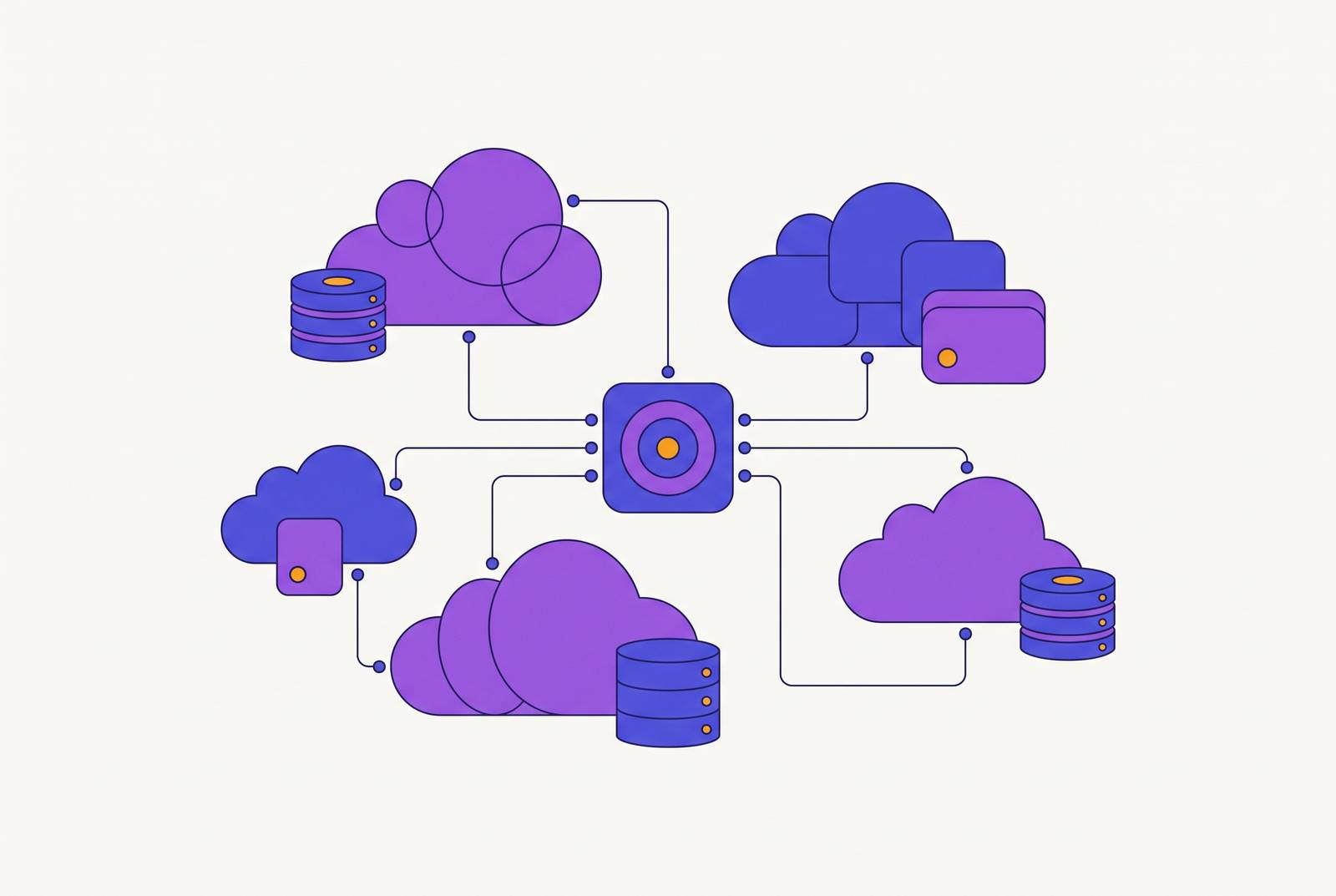
If interface consistency is your actual problem, you need a unified file namespace that spans multiple clouds without migrating data. A few platforms tackle this directly. Nasuni stores file data in scalable cloud object storage from multiple providers at once. Its UniFS global file system replaces data silos with a single namespace that supports unlimited scale, global collaboration, and built-in cyber resilience. As of March 2026, that backend support includes Oracle Cloud Infrastructure. AWS, Azure, Google Cloud, and Oracle all serve as backend stores and compute resources. Nasuni's Global File Acceleration claims to propagate data up to 20x faster across distributed teams. The trade-off is that it's a platform, not a filesystem primitive. You're buying into its architecture.
CTERA's Enterprise File Services Platform takes a similar enterprise approach. It runs at large banks, healthcare organizations, global media groups, and government agencies, with deployments scaling to tens of petabytes. NetApp Cloud Volumes ONTAP is self-managed and runs across Azure, Google Cloud, and AWS. It provisions block and file storage with data tiering to object storage, along with efficiency, protection, and hybrid multicloud control.
If "multi-cloud" actually means "migrating to a different cloud," per-cloud managed NFS services work fine. Google Cloud Filestore is GCP's managed NFS service with selectable service tiers. It doesn't cross clouds, but it removes the AWS-only boundary for GCP-primary teams. Azure Files natively supports SMB and NFS, which suits teams moving Windows workloads off FSx for Windows File Server. These are replacements, not agnostic solutions.
Alternatives for egress cost and object storage lock-in
When egress cost is the bottleneck, you need a storage layer that doesn't care which cloud sits underneath it. S3-compatible object storage with zero or near-zero egress pricing is the mechanism that makes this possible. S3-compatible APIs have become the practical standard. Any tool that speaks S3 can point at AWS, GCP, Azure, or Cloudflare R2 without code changes. Archil, a serverless filesystem that mounts S3, GCS, and other object stores as native POSIX filesystems, sidesteps the portability trap by treating your existing buckets across any cloud as the persistent source. No migration, no per-cloud reimplementation, and the same file interface works on AWS, GCP, and Azure without rebuilding storage architecture for each.
Cloudflare R2 removes the egress moat entirely. Open table formats like Apache Iceberg and Delta Lake add transactional reliability, schema enforcement, and ACID compliance on top of object storage. The data lakehouse becomes a viable cloud-agnostic analytics layer that doesn't require migrating to a proprietary file system.
Google Cloud Storage Rapid, announced at Google Cloud Next '26, uses Colossus to deliver very high bandwidth and sub-millisecond latency in a single zonal bucket. It integrates with PyTorch and JAX. Checkpoint restores and writes run significantly faster than traditional object storage. That's relevant if GCP is your primary training environment rather than AWS.
One structural friction remains. Each cloud vendor provides its own networking library, which works against genuine multi-cloud interoperability. The AnyBlob research project from VLDB addresses this by providing a unified multi-cloud download manager that bypasses vendor-provided libraries. Tools that cache only active data locally while keeping the object store as the authoritative copy, Archil being a concrete example, meter consumption down to what's actually in use and ensure egress is paid only on data that genuinely leaves your bucket. That collapses the per-gigabyte trap that turns multi-cloud more expensive than single-cloud.
Alternatives for AI agents and training jobs that need a persistent, portable file interface
AI workloads need more than object storage read access. They need a writable, POSIX-compliant file interface that persists across sessions and scales elastically. That's where cloud filesystem layers that mount directly on existing buckets become relevant.
The filesystem is a natural interface for AI agents because frontier models train heavily on bash and file manipulation. Agents prefer a filesystem over bespoke API tools. Training jobs and agentic pipelines need storage that follows the compute. Downloading datasets before inference or training begins is wasted work that delays every run.
POSIX semantics matter in practice. Atomic rename, flock and fcntl, mmap, fsync, hard links, symlinks, sparse files. Without them, existing training code requires rewrites. S3 Files explicitly does not provide enforced byte-range locking, which rules it out for applications that depend on POSIX locking. Persistent shared agent context, meaning the same filesystem mounted on many servers at once with shared reads and writes across parallel runs, is a requirement for production agentic systems. S3-native or ephemeral scratch storage can't meet it.
Archil is storage-agnostic by design. S3, GCS, R2, and Azure Blob all mount the same way. That directly addresses the interface consistency problem without migration. Capacity is elastic and billed on what's actively cached, which suits agent workloads where storage demand is unpredictable. For distributed training across cloud boundaries, a filesystem layer that mounts your bucket natively on any cloud, without requiring migration or per-region replication, lets GPU clusters in AWS, GCP, or Azure access the same training data with zero-copy semantics. Storage stops being the bottleneck to workload portability.
Archil also ships serverless execution alongside the filesystem. An agent can run commands directly against its filesystem without a separate sandbox. It gets a stable workspace to read, write, and execute against across sessions and parallel runs. Pricing is metered on active use. Cold data stays in your own bucket at bucket prices. Resilio handles a different need. If you want high-throughput file replication across clouds rather than a unified namespace or POSIX filesystem layer, that's its niche.
How to match the right alternative to the FSx limitation that's actually costing you
Start by naming the failure mode. Is it interface consistency? Egress cost? AI workload portability? Conflating them leads to architecture that solves the wrong problem. The diagnostic is simple: which one is actually slowing you down?
If interface consistency across clouds is the issue for enterprise file workloads, think global teams, NAS replacement, collaboration. Then Nasuni, CTERA, or NetApp Cloud Volumes ONTAP fit. They abstract the cloud layer, but they carry operational overhead and enterprise pricing. That's the trade.
If egress cost and object storage lock-in are eating your analytics or lakehouse budget, cloud-agnostic object storage layers address the trap directly. Cloudflare R2 plus open table formats on S3-compatible storage. These aren't file system replacements. They're storage architecture choices that remove the pricing moat.
If you're giving AI training jobs and agents a persistent, POSIX-compliant file interface that follows compute across clouds without migration, cloud filesystem layers that mount directly on existing buckets are the relevant category. Archil mounts S3, GCS, R2, and Azure Blob as a real POSIX filesystem with NVMe caching and elastic billing. Resilio handles cross-cloud replication for teams that need file sync rather than a unified namespace.
The strongest objection to multi-cloud storage is fair. Same-cloud storage often wins despite higher list pricing because intra-region transfer is free. Pulling data from an external provider at egress rates can negate storage savings entirely. But this objection dissolves when compute genuinely can't be co-located with storage. GPU scarcity, regulatory data residency, and multi-region AI pipelines all break the assumption.
The EU Data Act's egress switching fee ban takes effect January 12, 2027. The economic argument for single-cloud lock-in weakens over the next year. Teams making architectural decisions now should build toward portability, even if they don't fully execute it yet.