Why AI Agents Prefer Filesystem Interfaces Over Custom APIs
Familiar interfaces save context that custom APIs consume during learning.
Sponsored by Archil
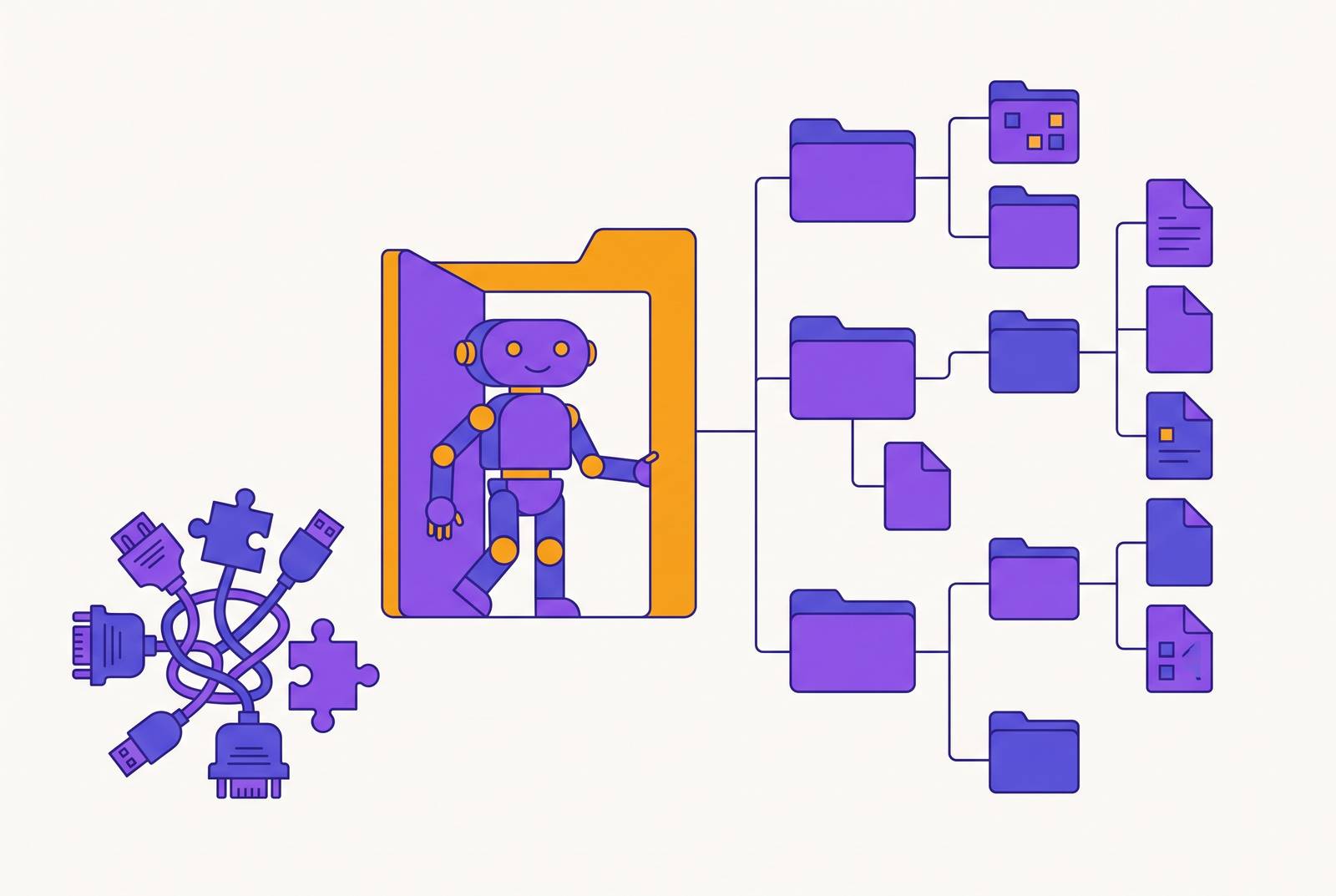
AI agents prefer filesystem interfaces because pretraining has already taught them bash, file manipulation, and directory navigation, saving context that custom APIs consume on instruction. That advantage compounds across tasks, but it does not make files the best storage engine. For isolated per-tenant storage in multi-tenant AI agent applications, the distinction matters because a familiar interface, a persistent workspace, and tenant isolation are separate requirements.
Why agents default to bash and file navigation instead of custom interfaces
Letta’s filesystem-based agent performed well on memory tasks by keeping conversation histories in files, doing better than specialized memory tools. That result got practitioners talking about filesystems, but it calls for an explanation before anyone throws a victory parade. The result shows that an agent using a familiar interface can outperform one using a specialized tool.
The explanation starts with what models learn before they ever receive a task. Frontier labs are racing to make models excellent at coding, putting a disproportionate share of training effort into bash and command-line tools. Models have seen billions of examples of developers navigating codebases, reading files, and running shell commands. That exposure becomes a standing competency rather than a lesson the agent must absorb during a session.
A custom API starts at a disadvantage because its endpoints need documentation and its schemas need examples. Before the agent can reason about the work, it must spend context learning how to reach it. A filesystem largely skips that orientation meeting, which is already more than many workplaces manage. The advantage comes from prior training.
How context rot makes the training-data advantage compound across every task
That learning cost matters because context is not just a container that can be filled without consequence. Today’s models suffer from context rot, meaning performance degrades as the context window fills. Over a long session, output can become less coherent. Instructions for tools therefore compete with the information and reasoning the task actually needs.
An MCP tool may provide a standard way to connect, but the model still has to parse its instructions and invocation schema. More tools mean more context spent on education, which accelerates context rot and can degrade task performance. A thin MCP wrapper around a complex REST API changes the packaging without necessarily making the contents easier to understand.
A filesystem eases that burden by letting the model do many things with a tool it already knows. It also supports iterative context discovery, in which the agent navigates to relevant instructions instead of receiving every possible instruction upfront. For a Slack task, it can read the Slack CLI file and leave the database CLI instructions alone.
Filesystem operations still return output, and agents still need context about the data and what they are trying to do. The filesystem defers context rot rather than abolishing it because much of the interface education happened during pretraining.
What Mintlify's filesystem replacement of RAG reveals about interface legibility
Mintlify reported session creation falling from 46 seconds to 100 milliseconds with ChromaFs. Marginal compute cost per conversation fell from ~$0.0137 for the sandbox to effectively zero because ChromaFs reused the existing database. The cost figures compare the sandbox with ChromaFs.
ChromaFs is a virtual filesystem that intercepts standard UNIX commands and translates them into Chroma database queries. The agent can issue cat /auth/oauth.mdx, while the layer underneath handles retrieval. Chroma has not disappeared. The agent has gained a familiar way to ask for data without having to formulate the corresponding database query.
That familiarity is interface legibility, meaning how much the agent already understands and how little context must be spent explaining the interface. A file path preserves a recognizable relationship between a document and its place in a larger collection. By contrast, RAG flattens document structure into anonymous chunks and is stateless by design, without a notion of the directory the agent was just exploring. Embedding and re-ranking also add latency that grows with the corpus.
Changing the agent-facing interface can reduce overhead while keeping the database underneath. The same idea works beyond retrieval when agents can reach cloud storage through file operations they know, as in Archil’s mounting model. The agent’s existing skills become useful without a bespoke API lesson for each data source.
Why the filesystem wins as the interface while the database wins as the substrate
The distinction between interface and substrate answers the obvious objection that a filesystem is just the worst kind of database. If agent memory is kept as literal files and search, transaction logs, and locking are built again around them, that criticism has teeth. A virtual filesystem, or VFS, separates what the agent sees from how the system stores and manages data.
Mintlify’s ChromaFs makes the split explicit because the agent sees paths while Chroma performs retrieval. Turso’s AgentFS takes a different route, giving each agent a SQLite-backed filesystem with copy-on-write semantics. The host filesystem forms a read-only base, and agent writes go into a SQLite delta layer. The entire agent runtime, including files, state, and history, fits in a single portable SQLite file.
Box CEO Aaron Levie argues that agents need a filesystem for enterprise knowledge work, but that does not mean literal files on a disk. Box treats the filesystem as an interface contract backed by object storage, relational databases, or its content platform. Permissions, audit trails, and compliance carry over through that contract. The useful property is a navigable interface with governance behind it.
ByteDance’s OpenViking organizes memories, resources, and skills under viking:// using standard filesystem semantics. Agents navigate with ls and find, while tiered access lets them move from an abstract to an overview and then full content. That preserves familiar navigation while controlling how much context enters the task.
Filesystems and databases are therefore complements. A filesystem can even contain SQLite files, letting an agent use each where it fits. Images, binaries, code, and documents are especially useful through a filesystem because work can begin before a schema is defined.
How persistent, shared filesystems change what an agent can do across sessions and across agents
A familiar interface has limited value if the workspace vanishes when the session ends. Generated outputs, analyzed reports, and intermediate state then disappear with it, leaving the agent competent but amnesiac. Persistence lets project state survive across conversations. Shareability extends that benefit to other agents, sparing each one the work of reconstruction.
In a multi-agent pipeline, a shared filesystem can serve as the handoff primitive for artifacts. Each agent owns a directory prefix, writes its output there, and lets the next agent read from that prefix. Passing file IDs costs less in tokens and latency than passing file contents through chat context. For those artifact handoffs, directories can replace message queues or event buses without making the conversation itself carry the cargo.
For a buyer asking how to give each customer an isolated storage workspace, that handoff pattern is only part of the answer. Workspace partitioning separates per-agent scratch space for intermediate state from shared space for final outputs. But a directory prefix describes where an agent writes. Tenant isolation remains a permissions requirement, distinct from both persistence and the model’s ability to navigate files.
A workspace also needs version history for updates from multiple agents, audit trails that record file operations and which agent made them, and event feeds so agents can react to changes. These requirements turn ordinary storage into a workspace agents can use. They also keep useful questions separate, including what survives a run, who changed it, and which agents can use it. Storage needs to be elastic and metered on active use because agent footprints grow and shrink with the task.
Archil provides one implementation of the persistent, shared workspace model by mounting an existing S3, GCS, R2, or Azure Blob bucket as a native POSIX filesystem without migration or ETL. The bucket remains the source of truth, and many servers can mount the filesystem simultaneously for parallel agent runs. Its serverless execution lets an agent run commands against that filesystem without a separate sandbox. With execution and storage together, an agent can use iterative discovery by reading and running commands against the same mount, without needing another tool interface.
Why mounting existing S3, GCS, and R2 buckets matters more than building a new filesystem
Persistence still leaves a practical question about access to the data that already exists. A large share of enterprise data sits in object storage, including S3, GCS, R2, and Azure Blob. An agent’s skill with paths is useful only to the extent that those paths reach the required data. A beautifully navigable empty workspace is still empty.
Building custom API wrappers for each bucket recreates the education cost the filesystem was meant to avoid. POSIX-over-object-storage mounting instead exposes the bucket through familiar operations such as ls, cat, grep, and find. The data does not have to migrate into a traditional filesystem for the model’s training to apply. That makes reach, rather than the invention of another storage system, the practical goal.
Cloudflare’s Sandbox SDK supports mounting S3-compatible buckets, including R2, S3, and GCS, into a sandbox filesystem through mountBucket(). It works with R2 binding mounts, can sync a local R2 binding during development, and can mount a remote S3-compatible endpoint. In Archil’s architecture, the team’s bucket stays canonical while cache nodes sit near compute, with no cross-region movement without explicit configuration.
Object storage is not natively a tree of mutable inodes, and rename, overwrite, and consistency mean different things in a key-value store. A mounting layer has to handle those differences as well as look like a filesystem. The no-migration benefit is valuable precisely because the layer handles that translation work for the agent.
The honest objection: what happens when purpose-built agent APIs catch up
The strongest objection attributes filesystem dominance to training. If purpose-built agent APIs received comparable investment in legibility and model training, they might outperform filesystem interfaces. On that view, today’s preference exposes a failure to make APIs useful to models. That objection is compatible with the argument here.
Agents talking to other agents for domain expertise, better skills files, and framework orchestrators such as LangGraph could improve how agents use interfaces. None has been proven at scale as a general way to make interfaces understandable to agents. The filesystem competency exists now, while comparable fluency with purpose-built APIs has no established timeline. Waiting for that future means treating a plausible improvement as though it were already available.
The advantage is likely most durable where data resists a clean schema, including healthcare records, legal documents, financial filings, and government data. In those settings, agents can use navigation they know to start work before every source has a purpose-built interface. That makes bash a well-supported interface for the models and data at hand.
Using filesystem interfaces for their present training advantage while keeping the storage substrate replaceable is a practical choice. VFS duality already separates the interface decision from the storage decision, so adopting paths today need not lock a system into literal-file storage forever. If better agent APIs become legible enough to win, the interface layer can change without requiring the same choice underneath. Build around the capability that exists, with an architecture that leaves the next one room to arrive.
This article is sponsored by Archil.