Object Storage vs Block Storage Trade-Offs
Storage bottlenecks cost AI training hundreds of millions in wasted GPU compute.

Object Storage vs Block Storage Trade-Offs.
Why the object-vs-block decision is harder in 2026
Object storage and block storage make fundamentally different architectural bets (scalability and economics versus latency and POSIX semantics), and choosing between them comes down to matching those bets to the specific access patterns and performance requirements of each workload. Global spending on AI infrastructure blew past $250 billion in 2025, and storage and networking are growing at nearly the same clip as the compute everyone actually talks about MinIO / AI Storage Architecture Object Storage vs Block Storage for AI Workloads - Zilliz Vector Database. Yet more than half of organizations say storage bottlenecks are capping how well their AI systems perform, and 57% admit their data isn't even in shape to be used for AI in the first place MinIO / AI Storage Architecture.
The old rule of thumb, object for scale, block for speed, still holds some water, but it's not the whole story anymore. Caching layers, purpose-built AI object stores, and cloud-native filesystems have started smudging that line pretty aggressively. What follows is a map of which bet fits which job. It's a map of which bet fits which job, moving from the architecture itself through training, into inference and agents, and out the other side with something you can actually act on.
What block storage and object storage are, structurally
Block storage works in raw, fixed-size chunks that attach to one server at a time, with a filesystem layered on top so applications get POSIX semantics and can edit data in place. Amazon EBS and a traditional SAN are the textbook examples, and if you want the fastest version of this idea, it's bare-metal NVMe wired directly into the compute node, no network hop involved.
Object storage flips the model. Data gets stored as an object, bundled with metadata and a unique key, sitting in a flat namespace and reached over HTTP/REST through GET and PUT calls, effectively immutable so you replace rather than edit. There's no editing a paragraph in place here. Objects are effectively immutable, so changing anything means replacing the whole object, not patching a byte. Amazon S3, Google Cloud Storage, Azure Blob Storage, and self-hosted options are the usual names attached to this model. Block storage doesn't carry rich metadata, and that gap is exactly where object storage earns its keep for AI data management, since every object can carry tags, lineage, and context that a raw block never could.
That immutability isn't a limitation so much as a trade. Object storage gives up per-request speed in exchange for near-unlimited scale, durability high enough that S3 advertises 99.999999999%, and the lowest cost per gigabyte on the table Object Storage vs Block Storage for AI Workloads - Zilliz Vector Database. Access patterns diverge just as sharply: block storage is a device with a filesystem sitting on top of it, while object storage is an HTTP API talking to a flat namespace. And on plain cost per gigabyte, block runs higher, object runs lowest, full stop. None of this makes one architecture better than the other in the abstract. It just sets up why each one breaks under different kinds of pressure, which is where the story gets interesting.
The GPU starvation problem that makes storage architecture consequential
GPUs sit idle between batches, waiting for data rather than computing, the core GPU starvation problem. It sits idle, burning money while doing absolutely nothing, which is the definition of GPU starvation.
This isn't theoretical. Meta found that 56% of GPU cycles were stalled because the silicon was waiting on training data introl.com. Over half the expensive silicon, twiddling its thumbs.
Part of the problem is that AI training asks storage to be two contradictory things at once. During checkpointing, it needs to handle large, sequential writes, which is a throughput-heavy job with a completely different shape. Most legacy storage architectures were built to be good at one of these, not both. Training doesn't care about that limitation. It demands both patterns simultaneously, which is exactly why "just pick block" or "just pick object" falls apart the moment a real training run starts. Neither one, alone, solves this dual-personality problem. The checkpoint side of it, in particular, turns out to have a very specific, very unpleasant price tag attached. Hammerspace reports that an H100 moves data through its memory subsystem at over 3 TB/s, while conventional network-attached storage delivers only 10–40 GB/s, a gap of 30–100x hammerspace.com.
What checkpoint overhead costs at scale
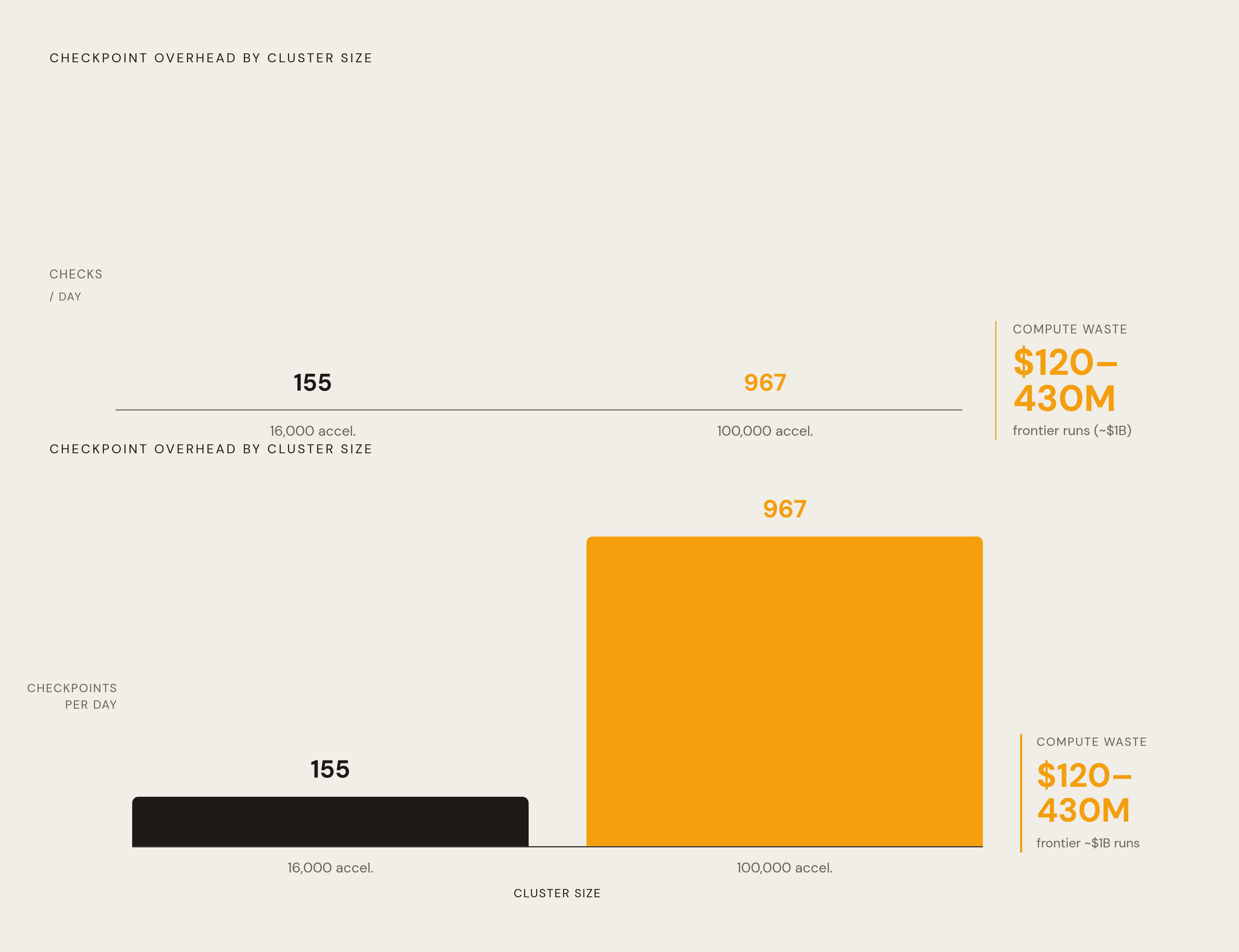
Checkpointing exists purely so a failed node or a reclaimed spot instance doesn't erase days of training progress. But at scale, checkpoint overhead eats up somewhere between 12% and 43% of total training time arxiv.org Object Storage vs Block Storage for AI Workloads - Zilliz Vector Database. That's not a rounding error either, that's nearly half a training run's clock time in the worst case, spent just writing safety copies.
The scale of this gets absurd fast. A cluster running 16,000 accelerators needs roughly 155 checkpoints a day arxiv.org. Push that to 100,000 accelerators and it's 967 checkpoints a day, nearly one a minute hammerspace.com arxiv.org spheron.network. For frontier training runs approaching $1 billion in compute cost, that overhead translates into $120–430 million in pure waste hammerspace.com arxiv.org Object Storage vs Block Storage for AI Workloads - Zilliz Vector Database. Not spent on progress. Spent on friction.
Zoom into a single job and the number gets easier to feel. Run 1,000 of those checkpoints over a week and you've burned somewhere between 67 and 80 hours of GPU time, just on the act of saving spheron.network IDrive e2. At $4.06 an hour on demand per H100 across an 8-GPU node, that wasted I/O time alone runs past $2,100 per job hammerspace.com spheron.network. And that's before anyone directly weighs object storage against block storage.
Object storage's tens-of-milliseconds latency multiplies under load rather than staying an abstract number. At 35 milliseconds of S3 PUT latency and 144 checkpoint events per job per day, 200 concurrent 64-GPU jobs waste roughly 18 GPU-hours of capacity daily, just from the latency tax on every save IDrive e2 Object Storage vs Block Storage for AI Workloads - Zilliz Vector Database. Writing checkpoints straight to S3 is cheap on the storage bill and expensive on the GPU bill, which is exactly backwards from what anyone wants. The fix that's emerged in practice is a fast intermediate layer, local NVMe or a parallel filesystem, that absorbs the write instantly and flushes to object storage later, asynchronously, while the GPU has already moved on to the next batch.
How the AI training pipeline distributes data across storage tiers
That fast-write-then-flush pattern isn't a one-off trick, it's become the standard shape of the whole pipeline. Raw training datasets, running from hundreds of gigabytes into multiple terabytes, live in S3-compatible object storage because it's cheap, durable, and reachable by many compute nodes at once. When a training job actually needs to compute on a batch, it pulls that data out of object storage and into local NVMe or attached block volumes, where the speed lives. Inference, meanwhile, tends to run on VMs backed by block storage locally, because consistent low latency matters more there than raw scale.
In the highest-end clusters, parallel filesystems sit as a layer between object storage and the compute nodes, purpose-built to handle both the sequential throughput checkpoints need and the random-access IOPS data loading needs. A rough planning number appears repeatedly in practice: budget around 4 gigabytes per second of read bandwidth per GPU for data-heavy workloads rdp.in. That's not a small ask when a cluster has hundreds of GPUs sitting in it.
The benchmark numbers back up just how much throughput this actually requires. One deployment delivered 720 gigabytes per second out of just 8 storage nodes to power 768 H100 GPUs hammerspace.com introl.com Object Storage vs Block Storage for AI Workloads - Zilliz Vector Database. GPUs sit idle between batches, waiting for data rather than computing, the core GPU starvation problem.
Vendors have noticed. Dell's AI Data Platform, announced at GTC 2026, bundles a parallel filesystem pushing up to 150 gigabytes per second per rack alongside a system that runs file, object, and parallel-file software together on the same servers nextplatform.com Object Storage vs Block Storage for AI Workloads - Zilliz Vector Database. The industry isn't converging on "pick object or pick block." Dell's AI Data Platform, announced at GTC 2026, introduced the Lightning File System and Dell Exascale Storage combining file, object, and parallel file software in a single 4-in-1 system, signaling that major vendors are converging on unified multi-tier architectures rather than separate systems nextplatform.com Object Storage vs Block Storage for AI Workloads - Zilliz Vector Database. Object versus block, for a serious training workload, is close to a false choice. The real decision is which tier handles which job, and how cleanly they pass data between them. NetActuate describes the layered pattern that has emerged in practice as follows. Software Seni reports that IBM Storage Scale achieved 656.7 GiB/s reads for 1T model training softwareseni.com Ceph. Hammerspace reports that a 512-GPU training cluster requires sustained 400–600 GB/s during data loading phases arxiv.org.
Where object storage has matured
Object storage's per-request latency still sits in the tens of milliseconds, versus sub-millisecond for local block. That's not a bug waiting on a patch. It's the defining, permanent trade-off of the architecture.
What has changed is throughput at scale, and the recent benchmarks show real movement. Separately, a July 2026 benchmark of IDrive e2 showed it leading in 9 of 12 GET categories, peaking at 1,034.81 mebibytes per second under 10-thread load, with LIST operations running at 71,467.78 objects per second and 14-millisecond time-to-first-byte; AWS S3, in the same test, showed the lowest variance with a coefficient of variation of just 6.7% hammerspace.com arxiv.org spheron.network Object Storage vs Block Storage for AI Workloads - Zilliz Vector Database. At the cluster level, Ceph scaled nearly linearly up to 12 nodes for objects over 32 mebibytes, peaking around 65 gibibytes per second aggregate on writes and roughly 115 gibibytes per second on reads arxiv.org.
Small objects are still the sore spot.
The industry's answer has been to build object storage specifically for AI rather than adapting general-purpose object storage after the fact MinIO / AI Storage Architecture Object Storage vs Block Storage for AI Workloads - Zilliz Vector Database. CoreWeave's AI Object Storage, generally available since March 2025, is S3-compatible and exabyte-scale, claiming 2 gigabytes per second per GPU that holds up even scaling to hundreds of thousands of GPUs, largely thanks to a local caching layer that keeps frequently accessed data on NVMe right inside the GPU nodes Object Storage vs Block Storage for AI Workloads - Zilliz Vector Database. That's the same trick showing up elsewhere too: caching the hot data locally so most requests never have to make the full round trip out to the object store, with some implementations targeting a cache hit rate above 95% when the working set fits Object Storage vs Block Storage for AI Workloads - Zilliz Vector Database. Object storage's throughput ceiling keeps climbing. Its latency floor hasn't moved an inch, and that's precisely why every serious high-performance setup now puts a cache in front of it rather than waiting for the physics to change. StorageReview / Backblaze Q1 2026 found that in Backblaze's Q1 2026 cross-provider benchmark of Backblaze B2, AWS S3, Cloudflare R2, and Wasabi tested in US-East and EU-Central, the five-minute single-threaded download test showed AWS S3 leading at larger file sizes with 50.10 MB/s at 5MiB, 90.10 MB/s at 50MiB, and 91.40 MB/s at 100MiB, Wasabi leading at 256KiB with 9.20 MB/s, and Cloudflare R2 proving strongest in average download latency rather than sustained throughput hammerspace.com Object Storage vs Block Storage for AI Workloads - Zilliz Vector Database. Tigris benchmarks show small-object latency remains a genuine weak point, with R2's p90 PUT latency reaching 340 ms for small payloads, not a rounding error for workloads with many small objects.
Block storage's remaining strongholds
Block storage isn't going anywhere, and there are specific jobs it still owns. Transactional databases like PostgreSQL and MySQL need in-place updates and consistent sub-millisecond latency with real POSIX semantics, and object storage's immutable, replace-the-whole-thing model simply doesn't fit that shape. Boot volumes, the OS images and live VM state that a server needs the moment it powers on, need block semantics too. Real-time inference serving is another holdout, since consistent low-latency access to model weights and the KV cache tends to matter more there than any scale economics object storage could offer.
Oracle's own published numbers put a fine point on how far ahead block storage still is on raw performance: its BM.DenseIO.E5.128 bare-metal shape delivers SLA-supported 3.4 million IOPS on a 4K random-write FIO benchmark arxiv.org. Object storage isn't in the same conversation on a per-request basis. Oracle also flags locally attached NVMe as the fastest storage option available for AI clusters generally, explicitly preferring it over remotely attached block when latency for AI inference is the priority.
The catch, and it's a real one, is that block storage scales vertically. It's bound to a single volume attached to a single instance at a time, which is exactly why it doesn't serve distributed training well no matter how fast it runs. That single-attachment model is a feature when you want to avoid concurrent write conflicts, and a hard limitation the moment you need to share a volume across an entire training cluster.
How inference and agent workloads are changing the storage calculus
Training used to be the whole story. Not anymore. MinIO's 2026 report marks this as the year the center of gravity shifted from episodic training runs to continuous, distributed inference, where models get queried, evaluated, updated, and fine-tuned nonstop, and data gets touched constantly by multiple systems instead of being read once and archived Object Storage vs Block Storage for AI Workloads - Zilliz Vector Database. Azure's 2026 storage research shows autonomous agents fire off an order of magnitude more queries than a typical human user, and they do it around the clock rather than in the bursty patterns humans create, which puts a different kind of concurrency stress on both databases and storage that training workloads never had to deal with Object Storage vs Block Storage for AI Workloads - Zilliz Vector Database.
That changes what storage actually needs to deliver. Inference doesn't need training's sequential read throughput. It needs steady, low latency on model weights and the KV cache, which points straight back toward block or NVMe-backed storage. But agents need something block was never built for: a persistent, shared workspace that multiple sessions can read and write to over time, not a scratch volume that vanishes when the session ends. Block's single-attachment model doesn't stretch to cover that.
Complicating things further, agent data tends to be messy and unstructured, logs, intermediate outputs, code, half-finished documents, none of which fits neatly into a database schema, and historically all of it needed an ETL pass before anyone could query it. The pattern taking shape in response uses an object store as the durable, shared, multi-tenant backing layer, with a POSIX-compatible filesystem mounted on top so agents can just use ordinary shell commands and file operations instead of rewriting everything to speak an HTTP API. That detail about POSIX isn't incidental. Frontier models are trained heavily on bash and file manipulation, so a plain filesystem interface needs no SDK, no API translation layer, nothing extra, it's simply the interface these models already know how to use. Object storage mounted to look and behave like a real filesystem, with an NVMe cache sitting in front to hide the latency, is quickly becoming the default architecture for agent workloads, for exactly that reason.